Wednesday, March 11, 2009

Ban Ki-moon


A couple weeks ago, I met one of the most international influential people of today. He also has a name which many people may not recognize.


In this picture, you can see Mr. Ban Ki-moon and his wife, as well as Mr. Doss, special UN representative for DR Congo, and his wife. They are in front of HEAL Africa, who had the honor of receiving these honored guests. Dr. Likofata, HEAL Africa's Public Health Director, and Virginie Mumbere, Public Relations Director, received him along with other incredible HEAL Africa staff members.

Surprisingly, I had a special little moment with the UN Secretary General in the bright-orange HEALing Arts room when we welcomed him and his delegation to see the work HEAL Africa is doing to further help victims of sexual violence in the development of life skills. In this blurry picture, I got to translate for Mr. and Mrs. Ki-moon.
They listened to a short explanation of the program, admired what the women are accomplishing, and then like the rest of us, got lost in the beauty and charm of Congolese babies, namely lovely Baby Plamedi, who sported the HEALing Arts uniform of the day!


Mr. Ki-moom finished his visit with a public statement against sexual violence and an appeal to put it to end. This statement is available via email, just contact HEAL Africa.


Tuesday, February 17, 2009

Femme Noire, Femme Africaine (Black Woman, African Woman)


Yesterday I saw Francine, our beginner seamstress teacher, in the HEALing Arts room and complimented her beautiful new black hair and black outfit. She responded, “Femme Noire, Femme Africaine. Ni miye!” She wanted me to take this picture of her so people would see who she is: “Black Woman, African Woman. That is me!” and that she is proud of it!

The women in the room were giggling and chanting with her “Femme Noire, Femme Africaine!
Later Francine explained to me the source of this saying.
"Black Woman, African woman. Camaralaye was an African who went to Europe to do long studies. He wrote this letter to his mother, which I learned in elementary school in 1986:

« Femme Noire, Femme Africaine, Ô toi ma mère, je pense à toi. Ô dama, ô ma mère! Toi qui m’allaita. Toi qui me porta sur le dos, toi qui la première, m’ouvrit les yeux, ô prodige de la terre, je pense à toi. Femme de champs, femme de la rivière, femme de grande fleuve, je pense à toi. Femme de la résignation, je pense à toi. Ô toi ma mère, merci, merci pour tout ce que tu fû pour moi, ton fils si loin, si prêt de toi. D’après, Camaralaye, enfant noir. »

“Black Woman, African Woman, Oh you my mother, I think of you. Oh my dear, my dear mother! You who breast-fed me. You who carried me on your back, you the first, who opened my eyes, oh prodigy of the earth, I think of you. Woman of the field, woman of the stream, woman of the great river, I think of you. Woman of resignation, I think of you. Oh you, my mother, thank you, thank you for all that you did for me, your son so far, so near to you.From there,Camaralaye, black son.”

Friday, February 13, 2009

Kalemie, Calamity and Hope

I visited Kalemie for a short time with some friends from Airserve last weekend, and saw how incredibly beautiful and unspoiled this most-rich region of the Congo is. White sand beaches on Lake Tanganyika, with tall grasses whispering in the soft winds, sand bars shining deep in the blue waters, the sun bright like in the Caribbean. This picture is of Chelsie (my co-worker here), Dave (captain pilot), Erinn (friend from Minneapolis) and Tomie (engineer), enjoying the soft sand under bright clouds in the sky.
No one would guess the level of poverty and suffering here for women due to the war.
At HEAL Africa, we received several women with fistula. Like my new friend Janet, who told me shyly, “I am happy every time I see you!” It took me a while to figure her out. She sits off on her own, squatting due to her painful fistula, her big teeth always sticking out. Small eyes squinting not without expression; her guards up high. Today, I sat down next to her because I wondered if something was wrong. To my surprise, she happily told me her whole story. She is one of very few lucky women. She has a husband and a 5 year old son and is pregnant again. She was also raped, like so many others I meet here, by 5 Mai Mai soldiers in October, shortly after she had conceived another child from her husband. The violent rapes left her with a severe case of fistula.
Why do I say is she lucky? Well, for one, her husband has not abandoned her and is being supportive by taking care of their 5 year old while she is receiving medical treatment. Second, she is only 4 months pregnant, and is now in a safe place with good medical care to help her through the pregnancy and delivery. Our doctors will make sure that she does not get a worse case of fistula, and once she has delivered, she will receive a quality surgery that should help her recover quickly, since HEAL Africa is the first to treat her. Third, she is not subject to continuing heavy labor with her condition and pregnancy. Instead, she has the safety of the transit center. Fourth, she is receiving special counseling both psychosocially and spiritually to work on healing and forgiving the men who wronged her. Counseling also helps Janet see that as a woman, she can have a voice as well, and fight for the war to stop, for the violence against women to end. Fifth, she has never learned to read and write. She has no employable skills. After she learned about HEALing Arts’ programs, she stood up with me to enter the room and meet Francine, who teaches beginner seamstresses. As we walked out holding hands, she excitedly told me, “I will come in first and start learning how to sew. After that, I will start going to the classes that will teach me to write letters home!” She put her hand to her slowly growing belly, looked at it, then looked up and smiled at me. Slowly, she walked over to sit with some of the other women.
Yes, amid the horrors of her rape and fistula, Janet is lucky.

Saturday, February 7, 2009

16 Minors Freed!

On Thursday, January 28, I met again with the pastor from the jail. A heavy sense of discouragement weighed upon us as it seemed that it would be impossible to overcome all the challenges in bailing the children out of jail. I told the Pastor that if the children could not be out by this weekend and ready for the program’s commencement on Monday, we would not be able to do anything to help the children anymore. I also stated that on top of that, our budget was limited to a specific quantity, and I could go no higher. Simply put, if I could not have them out, we could not do the program.
The following morning I accompanied a group of HEAL Africa visitors, one of whom was a prison chaplain in the US. As he preached that morning to a joyful crowd of prisoners, the badly moistened firewood from the recent rains smoldered heavily around us, thick black smoke stinging our eyes and our lungs for an hour.
As we prepared to leave, the pastor pulled me aside and said that the jail wardens had agreed to allow the children to leave as long as the fines were paid. In fact, so much so, that he already had a signed letter of dismissal for all 16 of them! I looked at him in disbelief. “16 children for the price of 12?” I asked, “Where will they stay? They cannot simply go to the street!” A couple hours later, we had found spaces for the complete orphans in a Catholic street children home. Within a short time, their staff had picked up the freed boys and integrated them into their programs. We returned to bail out the last ones, who were all orphans as well but had somewhere to say in Goma with extended family. When we entered the VIP room, the children shone with anticipation. We took pictures and were celebrating until the warden pointed out that Liban was a complete orphan with nowhere to return to. Thirteen year-old Liban, who had eagerly put his jacket on and gripped his belongings, confirmed this, which sadly forced us to wait until the following work day, Monday, to put him into another street children’s home. His small face quivered in disappointment, even as the warden yelled at him that if he shed even one tear, he would never see the outside of the prison ever again. He tried to be strong, but his youthful 13 years betrayed his severe disappointment, and not a small amount of fear, as he looked at the cracked concrete floor. We mourned in compassion for him in our hearts, hurting at his vulnerability at having to stay extra nights when his fellow inmates knew that he was going to be leaving but they were not.
The other children joyfully walked out of the room and we made our way to front door, a red metal door that let bright rays of sun shine through old bullet holes and hatchet marks into the dark, dusty lobby. Their bodies were tense, hands clenched together, weight shifting from toes to heels, as if wanting to run outside before anyone changed their mind, and at the same wanting to hold back from fleeing too quickly.
We walked them out into the bright sunshine. Walked out, like when you leave somewhere to go home.
Once out, we reminded the boys that God gives us a new spiritual life for eternity through Jesus and that it is not every day people get a new life here on this earth. We encouraged them to live their new lives like Jesus said, and to be a blessing to those around them, to use their new freedom for good. Shyly, with eyes brimming with emotion, they nodded in agreement. We shook their hands and congratulated them on their new lives. Ever so silently, treading slowly on the rocky, bumpy soccer field in front of the prison, the young boys made their way across, stunned at the gift of freedom.

Notes: The first picture is the official letter of receipt for the payment of the minor's fees.
The second and third pictures are curtesy of Alissa Everett.

Monday, January 26, 2009

Obama and Congo’s Jail: Proud to be Free... But are We really Free when Others Aren’t?

This was the first time in my life I have ever worn red, white and blue on purpose. Last Tuesday I sat in a room full of Americans and internationals. Crowded around a TV, we eagerly watched Obama’s inauguration. We groaned in exasperation when the electricity shut down on us. The generator started up. Ups and downs, goose bumps and hope marked the charged feelings that emanated through the screen from the crowd listening to Obama, all the way to our little living room in DR Congo. For one moment, the world seemed united as we all held our breaths listening to Obama’s speech, his words painting a picture of hope and reconciliation, of facing difficulties and persevering as one to overcome them.
One statement stuck out to me and still goes around in my head: “Let it be known to those leaders, that they will not be known for what they destroy but for what they build.” (not verbatim)
Not destruction, but the building up of people and nations, including our own.
What are we building?
With these thoughts still running around in my head, I entered the Goma Central Prison early the following morning. I can’t count anymore how many times I’ve been here, but it doesn’t feel weird to be here. Only when I really think about it, it hits me that maybe it isn’t so common after all to have two young, blonde women interacting regularly with prisoners in an overcrowded jail. In one of the most lawless countries today. Through HEALing Arts, we have already been working with the women, teaching them to make banana leaf products. We have sat and talked and joked and prayed together.
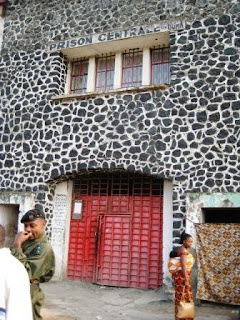
Today, I feel comfortable sitting in the empty little room that was burned during November’s recent war. The bare bench and plastic chairs suffice for our project.
We begin receiving all the minors, young boys from ages 11 to 17, who have been tossed carelessly into jail. In a country where you are guilty until proven innocent. Where none of these children have ever had a trial. Some have been here 3 weeks, some close to a year. HEAL Africa’s Choisir La Vie (Choose Life AIDs program) staff, Mama Noella and Pastor Olivier begin the interviews.
Truth be told, a problem that has become so apparent in Goma is the vast numbers of Child Headed Households (CHH). Many families, orphaned by AIDS, fall under the responsibility of the oldest child, whether he may be 17 or she may be 15. All their younger siblings, or their nieces or nephews, must be cared for. During our interviews, some told of living with a disabled grandmother who had no income. Some have no one, no shoes and tattered shorts. We continue down the list of children, hearing their painfully searing stories of abandonment, desperate survival, and unjust introductions into prison. Fear clouds their eyes, deep scars on their faces tell of stories not mentioned, fungus destroys their toe nails. Most have never studied enough to read or write.
We sit next to them and hear their stories and tell them of friends in Australia willing to support them by paying their $50 fees to leave the prison. Of friends in Mexico and Minnesota willing to invest in them by giving them small income generation grants so that they may be able to provide for themselves in honest, sustainable ways, as simple as they may be. Most say they have already participated in small activities like selling shoes, bread or gas on the street. They would be happy to have an opportunity to leave with hope and a fresh start. Most have no “home” to return to. No one but themselves cares about their survival.
Leaving the jail already exhausted, we drive around Goma, visiting other Child Headed Households. We ease our way among the sewer-muddied alleys of Birere neighborhood, trying not to gag at the sights and smells. Trying to not cry when I see the 4 year old boy rinsing the cut on his ankle with sewer water, his little friend trying to fill up a crushed bottle with the same trickle of “water.” We see brave young men of ages 19 and 21, who are each taking care of 4 children through selling things. We drive towards the volcano and tread over loose, sharp rock to other homes. Bleating goats, soldiers, police, dirty children, all of it becomes part of the scenery. We see the joy and hope of the young children that are able to go to school due to the hard work of their older sibling or caretaker uncle.
By the time we arrive home 10 hours after the start of our day, our feet are black with grime, our brains are mush.
However, I can’t help but think. A lot; thoughts seeking resolution, questions demanding answers. I’m struck again by the reality that we are one world. One humanity. Your problems are my problems and my problems are yours. This economic downfall has affected everyone in the world, not only the US. Since December, the local currency has already devalued from 500 Fc per dollar to 650 Fc. These orphans, not given opportunities, could end up becoming young criminals from desperation to satisfy their bellies. Given opportunities, they might be able to give their own children a hope and a future. They themselves could be agents of change in their country.
The bottom line that bothers me is that somehow, I am more “free” than they are because I have a passport and a background and support from others that allow me ‘out’ when things are bad. They don’t.
Am I really free if my brother or my sister is not?
Can our pride for our freedom drive us to fight for another’s liberty as well?

Wednesday, January 14, 2009

The Joy of the Hope of Success!

Quite a title, I know, but it was the best way I could capture that feeling!
Saturday, we helped our first group of women who have “graduated” from HEALing Arts’ sewing class to form their own association. Twelve women, all of whom have suffered incredible things, are now standing together and have decided to work jointly for their success and that of their families. From the woman who was raped and now has a beautiful 10 month old baby, to the young woman who shook in fear for hours in a dark ditch in the forest with a compound fracture, hiding from the soldiers who were rampaging her village, to the widowed and abandoned, to the woman who has finally received solid crutches so that she may move around with agility, despite the loss of function of her legs from polio.
All I could think was, “and I get to sit in the same room as these women?” HEAL Africa has treated every woman in this room, and now they are all healthy physically, emotionally and spiritually. One of the spiritual counselors, Mama Ciza, accompanied me in the car and could not help but exclaim over and over again in joy, “That one,” she would point, “she was so, so traumatized. And now look at her! She’s healed! She’s so strong! And that one, she was so, so devastated. And now see, she’s joyful, she’s so, so happy!” The crowd of 12 women and their babies, Mama Ciza, Annifa (manager of HEALing Arts) and I crammed into two vans. All of them, the sewing machines they had received as income generation grants from HEALing Arts, stools and baskets.
Loudly, we weaved our way in the hot sun, shining dust and endless streams of cars, motos and people, patiently sweating our way through the terrible planning of road construction: no alternate route. However, no one could put a damper on the energy and happiness in the cars!
HEALing Arts loaned these women money to help secure their first lease. There is no banking for the vast majority of Congolese, so they are obligated to pay 6 months up front in order to gain a lease, which renders most of them incapable of overcoming this first step. Together, they could pool together one month, but lacked $300 for the remaining 5, which they have received as a loan from HEALing Arts.
“Stop, we’re here!” Annifa’s voice took me out of my musings about a system that makes the poor suffer even more. A tiny red door in a long line of small businesses, right next to the market in the Katindo neighborhood. The women’s eyes welled with excitement, butterflies dancing in their stomachs. This would be their livelihood, the crib of their growth as independent, healed women who have formed a cooperative together, despite all odds. They have proved it! They have overcome yet again!
A squat lady with a large mole on her lip and a loud voice identified herself as the landlord and informed us that she had lost the key. Our driver, Theo, loudly banged on the padlock that bound the red metal door with a hammer until he was able to pry it off. Already our eclectic group of people had attracted an immense crowd of people and school children ogling the entrance of something brand-new into their commercial district. The red door screeched open with a puff of dust. Sparkling in the hot sun, dirt encased everything inside this little room with no windows that would now be 12 women’s work space. The men moved a fake wall, removed old, rotting furniture and broken tiles. As a previous landlord myself, I couldn’t help but laugh at how American renters would have treated me had I ever delivered an office to them in such a manner!
A fierce match was on for the final negotiations of the lease. “You promised to put in electricity, we don’t see it anywhere!” demanded Mama Ciza, Annifa and the interim association’s president, the woman in crutches. “I told you, we will put a cable in soon!” the thickset woman hunkered back. Latrine privileges, privacy, why we had to pay 300 francs for water to clean out the place.
Finally, Mama Ciza, the spiritual counselor, led us all in a time of prayer. All our voices could be heard together, thanking God for blessings and asking for protection and success in their new business. For strength to work well and be good mothers. For faithful clients. For many years to come and much work to be had. Loud singing and clapping followed. By the end of the afternoon, sweat pouring down and smiles bigger than the sky, the women had found the first home for their new venture. An undertaking which promises to bring many more adventures in the next months!

Monday, November 24, 2008

Sweet Moments in Life

May I have the pleasure of introducing you to three special people in my life...

Tate
Tate (grandmother in Swahili) is an ancient woman who is also a fistula patient. Her body has been weakened and emaciated by years of suffering and hard labor, but she is a dear person. Even when people steal her little bag of soap while she does other chores, she does not display bitterness.
The day that Chelsie and I returned from Rwanda after the attacks in and around Goma in late October, the first thing we did was to visit the women at the transit center at the HEAL hospital. They laughed and danced, celebrating that we were back, that we had not abandoned them. We played ball with some of the younger, louder women; talked with the children about school and how they felt when they were hiding under their beds listening to the gunshots; we joked with the older women about life and the process of existing. We also made the rounds to the post-op rooms for fistula patients, where Tate was recovering. As we were catching with up with Tate and getting to know the newer patients, Tate reached over and started playing with my hair. The other women gasped at her audacity to touch a white person’s hair. She glared at them with daring eyes and told them in a stern voice, “I’m her grandmother. She is one of us.” Then she turned to me and informed me, “I’m going to braid your hair. Sit on the ground.” Obediently, I eased myself in between the two plastic-encased mattresses on their simple, chipped aluminum bed frames, trying not to wonder when was the last time they were cleaned. Calmly, with wrinkled hands and decades of experience, Tate proceeded to braid my hair. The rest of the women sat comfortably around us, another barrier being broken forever between us. Although my braid looked beautiful, my spirit was lifted by this undeserved grandmother’s love.

Cristina
About a week ago, I was visiting some of the mamas in their living quarters. This particular day, I happened to be teaching them how to use my camera, and they were giggling hysterically at the pictures they were capturing. One of the young fistula patients walked into the room and when she saw me, she urged me to come and see something. The Mama took her newborn from her friend’s arms and put the baby in my arms. “Majina yako!” she exclaimed. Surprised, I asked, “you named her Cristina?” She nodded proudly as I held this beautiful little baby; my heart warmed all over as the infant stared deep into my eyes. The mother grabbed my camera and took this picture of my namesake.

Helena (Evira)
Helena you already know… she has received a few name changes since the time we met her in the middle of the road in Masisi, unable to walk and stiff to stretch her legs. She has now been at the handicap center, through the support of HEAL Africa’s “Children Like Us” program for children with disabilities. As she has been receiving nutrition, physical therapy, play therapy and care, she has gained much strength. The doctors estimate that in two or three more months, Helena will be walking completely on her own. Her mother beams with joy and pride as she describes how little Helena now sits like a normal person on a chair, how she can lift herself up, and how she has even started walking on her own if she can lean on a wall. Helena herself shines as she exhausts herself in her efforts to show me that she can even jump if I am walking with her! Yes, Helena will walk.